Media: 联合早报 聯合早報 Lianhe Zaobao
It has been over three years since the launch and widespread adoption of generative AI (GenAI). What began as a novel tool has now become a part of daily life. A recent wave of online enthusiasm over “Ghibli-style AI images” not only highlights how GenAI has permeated popular culture but also forces us to confront deeper issues: Do these AI-generated tribute images infringe on Hayao Miyazaki’s original work? Do they devalue craftsmanship? And what if the one being affected is you—how should you respond?
These questions go beyond creative ethics. They reflect the growing pains society is experiencing amid a major technological transformation. The lesson we learned from the industrial era is this: not every voice of dissent can stop the relentless tide of technological advancement. By nature, technological progress replaces low-end, standardized labor and reshuffles the value of human contributions—some rise as a result, but many are eliminated or pushed to the margins. Let's consider two deeply personal areas:
Human Work Patterns Are Rapidly Changing with AI
The ideal scenario is that machines free humans from labor, giving us more resources, time, and space to pursue our interests—possibly leading to a society with basic income.
The worst-case scenario, however, is that humans are replaced without proper safeguards, resulting in poverty, anxiety, or even becoming mere "mental slaves" feeding AI systems with cognitive data.
After the last article was published, both optimistic and pessimistic friends weighed in. Unfortunately, the current reality resembles more of an "intermediate state"—a limbo:
People are desperately learning new tools and chasing new tech. Digital technology has become an extension of the body—we can’t live without our phones or the next update.
This resembles a kind of prison-like life with no leisure time. Since the Industrial Revolution, we’ve gradually adapted to time clocks and the 9-to-6 grind. In the past 20 years, smartphones have tethered us to 24/7 availability, constantly handling social, work, and algorithm-driven trends. This is the root of the "busy and broke" culture mentioned in the previous article.
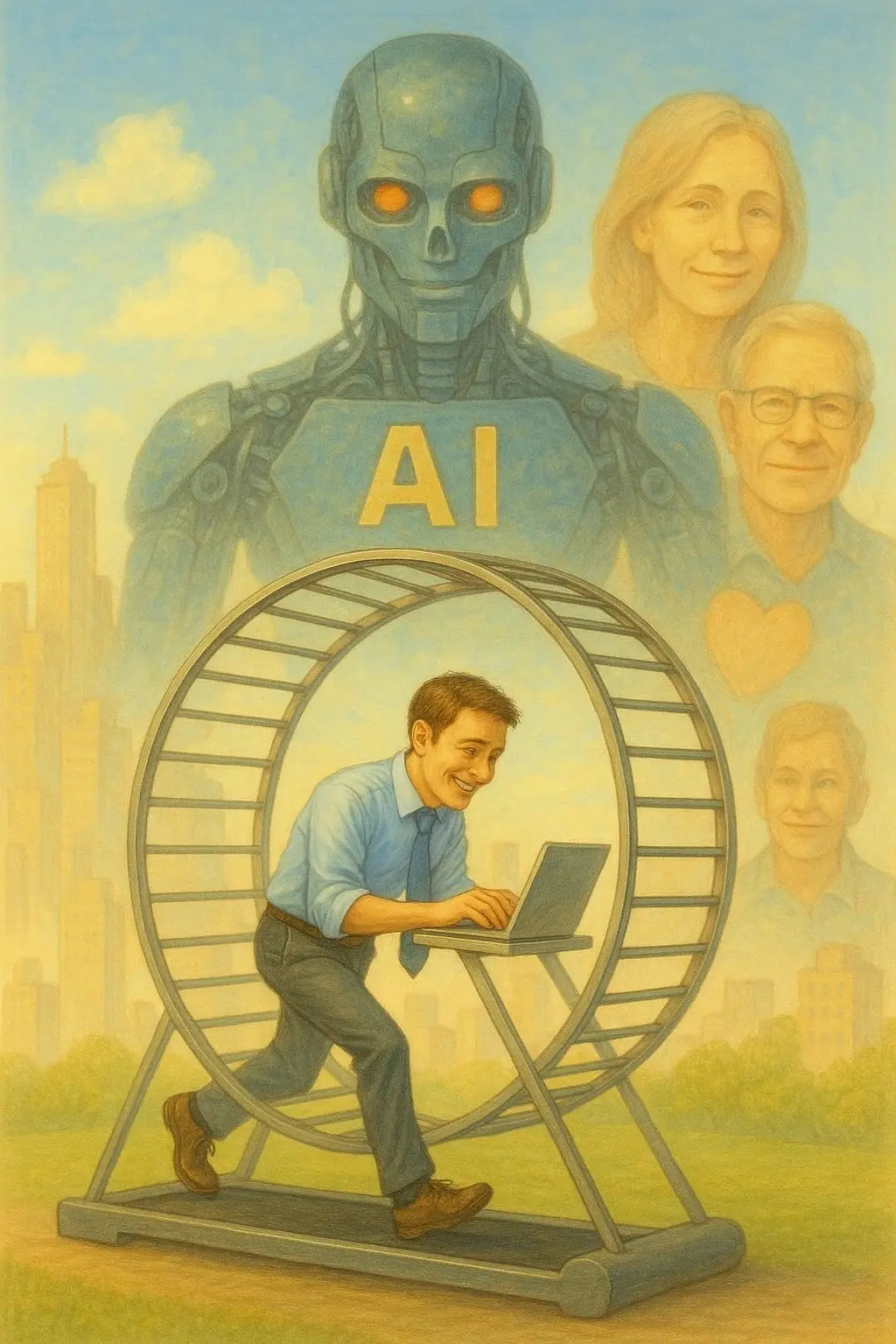
Now AI is taking this to the extreme. The young and middle-aged alike are sprinting in a hamster wheel of constant upskilling, trying to stay ahead and avoid obsolescence.
AI Isn’t a “Killer Robot,” But a “Civilization Killer”
Within just a few years, AI has become so advanced that AI-generated voices, photos, and videos are nearly indistinguishable from real ones. The era of “seeing is believing” has officially ended. One Australian radio station had an AI DJ broadcasting for months without anyone noticing. Online customer service, presentation writing, and video production are all becoming AI-driven. As a result, the necessity of human presence is now in question.
Historian Yuval Noah Harari issued a stark warning in an interview: AI's real threat is not to the human body, but to the foundations of human civilization—language, storytelling, and trust.
He explained that humans cooperate on a large scale not due to physical strength, but because of our ability to create shared fictions through language (e.g., laws, religions, monetary systems). These narratives are held together by language. Now, for the first time in history, AI can automatically generate language, bedtime stories, and scripts—and manipulate emotions and beliefs effectively. This marks the emergence of the first-ever “non-human storyteller.”
Once AI begins to influence human belief systems, it could destroy the system of trust through misinformation and psychological manipulation. If trust collapses, humans will lose the ability to cooperate and maintain institutional or social stability. This is not science fiction—this is already reflected in today’s world of extreme social division, political polarization, and rampant fake news.
Crisis and Reflection
The Return to Human-Centered Values
In areas where machines cannot truly replicate—like personal charm, approachability, and trust—humans still hold irreplaceable advantages. In future workplaces and societies, we may see a shift toward valuing “trustworthy people” and organizational skills over pure efficiency and technical ability.
The Rise of the Emotion Economy
As both material goods and knowledge become replaceable, what remains truly valuable is emotional energy and the quality of relationships. Addressing internal conflict, understanding others, and building connections—these unstructured “emotional values” may become the heart of the new economy.
Now Is the Time to Act
Harari calls for global regulations on AI—similar to how nuclear weapons were once controlled. These include: banning AI impersonation of real people, mandatory labeling of AI-generated content, and restrictions on AI involvement in elections and political discourse. These rules aren’t about stifling innovation but about protecting the core mechanisms of human cooperation—civilization and trust.
Every technological revolution has a "window of opportunity." Miss it, and there may be no turning back. Instead of endlessly debating whether AI art defiles originality or sidelines artistic professionals, we should ask a more fundamental question:
What is our position in this civilizational upheaval? Will we become hamsters that die running in a wheel of endless learning? How can we stay clear-minded and avoid becoming accomplices—or victims—of a civilization in decline?
Talk to us to solve your digital challenges.
#AI #Humanistic #Challenges #Matrix #GenAI #Commentary #Artificialintelligence