Media: 联合早报 聯合早報 Lianhe Zaobao
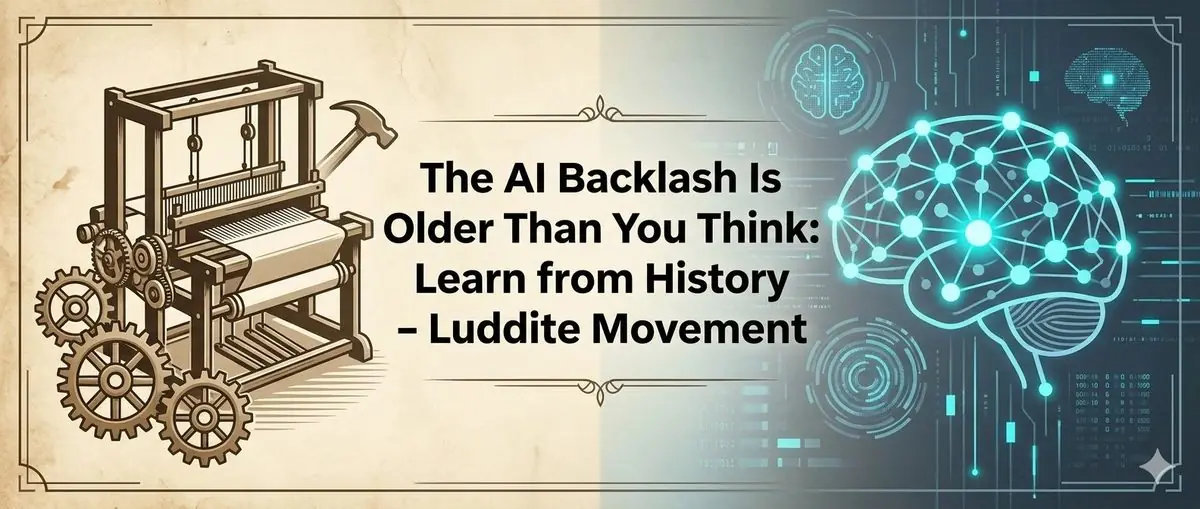
History does not repeat itself exactly, but it often rhymes in striking ways. Today, as many people worry about artificial intelligence (AI) replacing jobs and grow increasingly sceptical of its rise, a similar drama had already unfolded more than two centuries ago during the Industrial Revolution.
In the late eighteenth century, steam engines and mechanised production dramatically improved efficiency while disrupting the livelihoods of countless skilled craftsmen. Between 1811 and 1817, Britain witnessed the Luddite Movement, during which workers broke into factories and destroyed weaving and spinning machines in protest against machinery replacing human labour. However, the Luddites were not opposed to technology itself. Their anger stemmed from the way businesses used new technologies to suppress wages, weaken workers' bargaining power, and concentrate wealth further in the hands of a small group of industrialists.
Two centuries later, similar anxieties have resurfaced.
In recent years, the rapid development of AI has coincided with companies facing post-pandemic economic pressures. Many firms have undertaken large-scale layoffs under the banner of improving efficiency and accelerating AI transformation. At university graduation ceremonies around the world, corporate leaders speaking enthusiastically about an AI-driven future have often been met with boos from the audience. Former Google CEO Eric Schmidt, for example, was interrupted by jeers when encouraging students to embrace AI. Such reactions are not difficult to understand. In an already challenging job market, with companies such as Meta, PayPal, Cisco and Nike carrying out significant global layoffs, graduating students naturally see AI as a threat to their future employment prospects.
Yet there are different voices within the technology sector. NVIDIA CEO Jensen Huang has criticised companies that use AI as a convenient justification for workforce reductions. He argues that AI has only become widely adopted in recent years and cannot reasonably be blamed for layoffs that began much earlier. In his view, AI should enhance productivity and create new opportunities. In the future, those most at risk may not be people who lack AI knowledge, but those who fail to learn how to use AI effectively.
History, however, tells us that when people feel their livelihoods are under threat, emotions often outweigh rational arguments. Public sentiment is what it is, and anti-AI feelings are real.
Looking back at the Industrial Revolution, the Luddite Movement was ultimately suppressed. Over time, workers came to realise that destroying machines would not stop the march of progress. Instead, they organised labour unions to fight for their rights. Through decades of collective effort, they gradually secured many of the protections associated with modern employment, including the eight-hour workday, minimum wage laws, workplace injury compensation and retirement benefits.
However, these achievements have largely been enjoyed in Western societies. Across much of Asia, both white-collar and blue-collar workers often lack comparable protections. Over the past few decades, Asia has become the engine of global manufacturing, driven by large populations and relatively low labour costs. The AI revolution also presents new opportunities for the region. China and South Korea have advanced rapidly in applying AI technologies. In countries such as India and Vietnam, software developers remain more cost-effective than high-end data models and token-based computing resources, creating strong demand for technical talent. Meanwhile, Malaysia, Indonesia and India continue to invest heavily in hardware infrastructure.
At the same time, AI is triggering another restructuring of the workforce. Knowledge-based professions in places such as China, Japan and Hong Kong are already coming under pressure. By comparison, Singaporeans are in a relatively fortunate position. The government has actively promoted AI adoption across society and remains one of the few administrations offering substantial support and funding for AI-related initiatives. In some cases, public programmes have even stepped in to provide AI development services that might otherwise have been left to commercial providers. Furthermore, policies designed to protect local employment often mean that during layoffs, foreign professionals are more likely to be affected first. As a result, the impact on local workers has been comparatively limited.
Whether it is the steam engine or artificial intelligence, society's real concern has never been the technology itself. The deeper question is how the benefits created by technological progress are distributed. The Industrial Revolution gave rise to labour unions and worker protection systems. The AI era likewise calls for reskilling, lifelong learning and new forms of social safety nets.
Machines have no ideology. They are loyal only to efficiency. The real issue is not whether AI becomes too intelligent, but whether society can continue to ensure that the gains from progress are shared by the many rather than concentrated among the few. Otherwise, every technological revolution risks becoming little more than another reorganisation of social classes under a different name.
Talk to us to solve your digital challenges.
#ArtificialIntelligence #FutureOfWork #industrialrevolution #AIrevolution #Luddite Movement
#AI #AIAgents #GenerativeAI #history #aibackslash #IndustrialRevolution #socialsafetynets