Media: Lianhe Zaobao
It has been three years since the advent of generative AI (GenAI). What began as a novelty has now become embedded in our daily lives. The recent viral wave of “Studio Ghibli-style AI images” is more than just a cultural moment—it reflects GenAI’s full integration into popular culture and prompts a deeper question: while our output has become faster and more efficient than ever, has our quality of life actually improved?
“I'm busy every day, yet it feels like nothing gets done.”
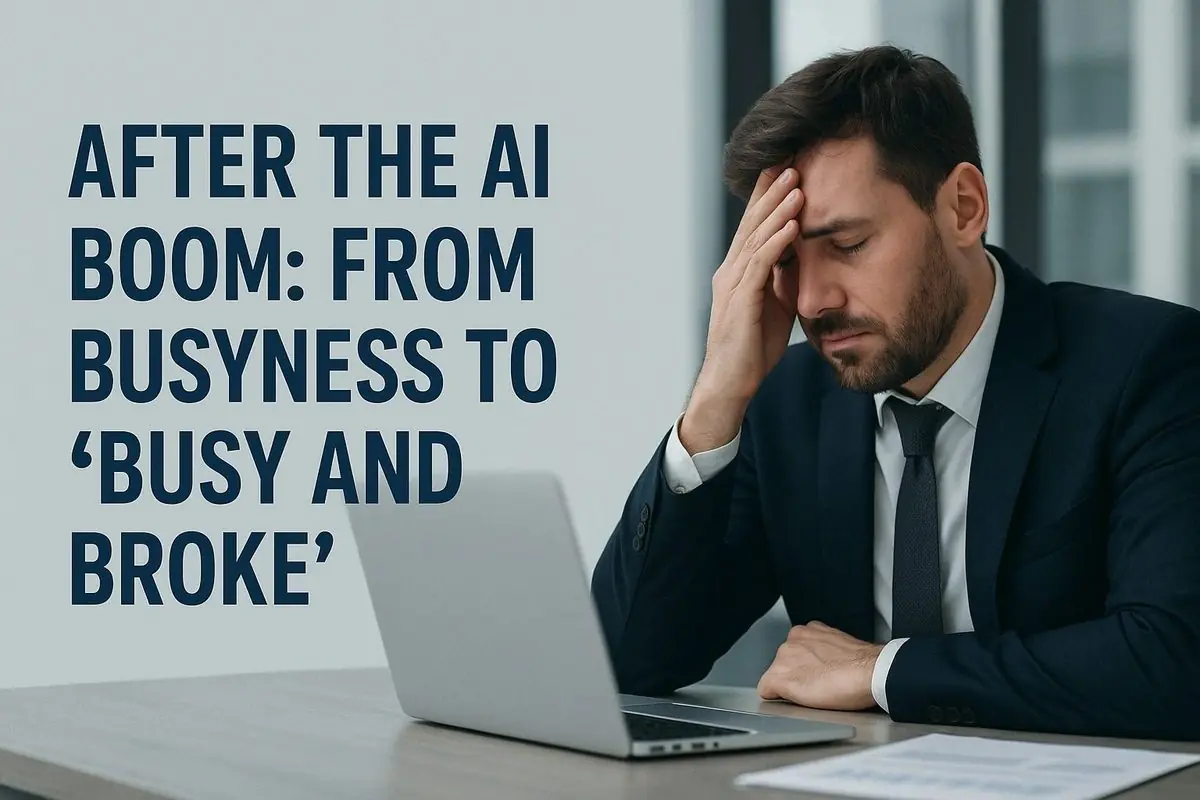
This sentiment captures a common reality of our times. There’s even a term for it: “busy and broke”—not referring to financial poverty, but a form of time and energy bankruptcy. It’s the condition of being perpetually occupied yet lacking in value, direction, or meaning.
The Rise of the Intelligent Economy
We are transitioning from a knowledge-based economy to an intelligent economy. Tasks that once relied on memory and logical training are now rapidly being taken over by AI. From generating reports and analyzing data to creating images, AI continues to erode the traditional value of learning and memorization.
For those living through this era, it feels like facing a new industrial revolution. Many are scrambling to keep up—rushing to integrate AI into their work in hopes of staying relevant and avoiding layoffs. But as technological innovation accelerates beyond even the pace of technologists themselves, ordinary people are sinking into a vortex of repetitive, low-value tasks. On the surface, we’re busier than ever, yet the work we do often fails to build capital, skillsets, or any real sense of achievement.
This type of busyness is often driven by external pressure—keeping up with trends online, showcasing our awareness (e.g., by posting Ghibli-style AI images), responding to messages, or learning to use GenAI for mundane tasks. Yet all of this reflects a lack of agency over our own time.
Imagine an office worker who rushes reports by day, works late into the night, then returns home only to catch up on group chats, emails, and social media—all while scrolling mindlessly and feeling like time is slipping away. Constantly busy, yet with no time for real learning, reflection, or rest. Even mental and physical health becomes depleted. This is the very picture of "busy and broke."
Before Clocks, Time Was Not a Commodity
Before the invention of the clock, time was fluid and cyclical. People rose with the sun and rested at dusk. Life flowed in harmony with nature—the farmer sowed with the sun, the fisherman sailed with the tide. Time was felt, not managed. Aside from the crowing rooster, no artificial reminders dictated the day.
The Industrial Revolution of the 18th century changed this profoundly. Time was now quantified—factories demanded precision, standardization, and discipline. Clocks entered the workplace; workers had to clock in and out. Being late became a fault, and efficiency became the new measure of worth. From that moment on, we no longer followed natural rhythms—we were bound to mechanical time. Busyness became an obligation, not a choice.
From Factory Floors to Offices—and Now, Work Without End
As society shifted from industry to knowledge and services, workspaces moved from factories to offices. The chimneys and clanging machinery may have disappeared, but productivity pressure persisted—now embedded in spreadsheets, KPIs, emails, and endless meetings.
The factory worker became the modern “office worker,” and while the punch card evolved into opening a laptop or logging into Slack, the clock never stopped ticking. With smartphones and instant messaging, the boundary between work and life has all but vanished. Your boss can reach you anytime. Work now permeates every crevice of our lives like an invisible fog. Even after you clock out physically, your mind remains on standby.
The New “Busy and Broke” in the Age of AI
Do you see the pattern?
AI was supposed to free us from drudgery and enhance productivity. Yet for many, it has simply accelerated the treadmill. We scramble to learn prompts, master tools—only to find that prompt engineers themselves are being phased out. The pace of information has increased—and so has our anxiety. Each day brings a new “must-know tool,” and a new fear: of falling behind, of becoming obsolete. The knowledge worker is no longer just a responder, but a perpetual upgrader.
We were meant to master technology, yet increasingly, it feels like technology is mastering us. Algorithms and social media stoke our insecurities—“Am I behind?” “Everyone’s using that AI tool—shouldn’t I be too?” Driven by this unease, we chase trends, flood content, and compete for efficiency—only to lose sight of our purpose. As AI generates more and more content, humans are relegated to fixing AI errors or becoming endless “learners” in a race with no finish line.
Redefining Meaningful Work
"Busy and broke" is not the fault of technology—it’s the result of how we choose to use it. In this AI-driven era, what we need most is not faster fingers, but sharper discernment. The question we must ask is not, “What have I missed?” but rather, “Is this kind of busyness meaningful?”
Only by redefining value and outcomes can we escape the cycle of "busy and broke." We must stop being slaves to time or servants of technology. The answer lies in our power to choose—wisely, intentionally, and with clarity.
Talk to us to solve your digital challenges.
#AI #ArtificialIntelligent #GenAI #worklifebalance #FutureOfWork #GenerativeAI #ProductivityTraps