Media: 联合早报 聯合早報 Lianhe Zaobao
Artificial intelligence is no longer just a fashionable topic in the tech world. It has become a civilizational contest. From large language models and generative media to AI agents and automated decision-making, the technology is spreading into nearly every corner of society, with the world seeming to edge toward a new industrial revolution.
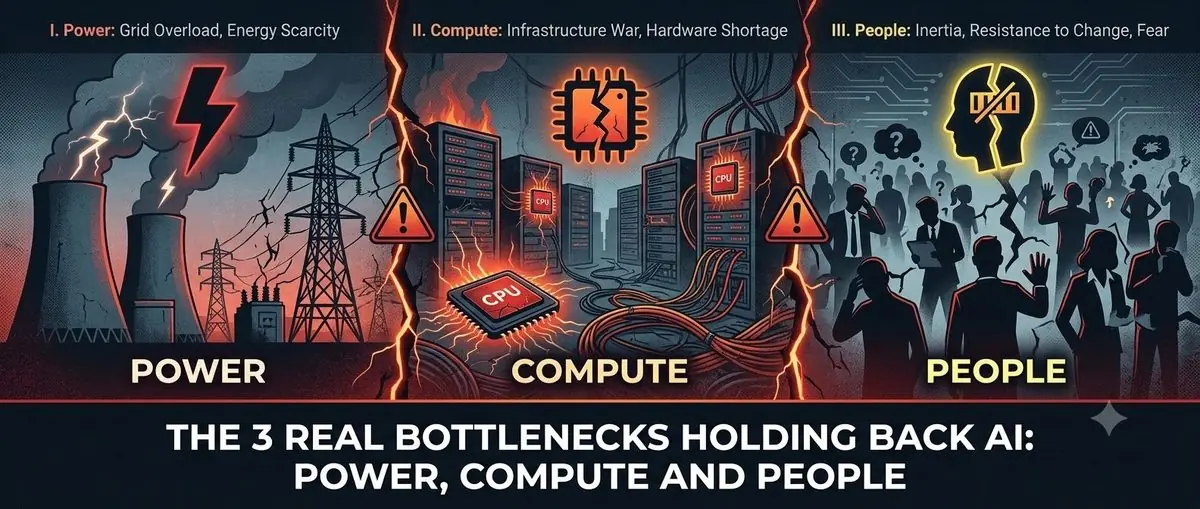
Yet while much of the industry remains intoxicated by the idea that “AI is about to change humanity,” the real obstacles to its next stage of development are not that the models are insufficiently intelligent. They are three heavier, more fundamental walls: power, compute and people.
And of the three, the hardest to overcome has never been the machine. It is the human mind.
I. Power: At the End of Civilization Lies Energy
The world of AI may look virtual, but beneath it sits something intensely physical.
Every prompt, every inference, every AI-generated image consumes electricity. AI does not float somewhere in an abstract cloud. It exists in one power-hungry data center after another.
According to research published by the International Energy Agency, data centers worldwide consumed roughly 415 terawatt-hours of electricity in 2024, and that figure is projected to nearly double to 945 terawatt-hours by 2030. This is no longer merely a technology story. It is an energy story. In 2026, the U.S. Energy Information Administration forecast that American electricity demand would hit record highs over the next two years, with AI data centers among the main drivers. The problem is that the expansion of the power grid is nowhere near keeping pace with AI’s explosive growth. A single hyperscale AI data center today can consume more than 100 megawatts of electricity — roughly equivalent to the annual usage of 100,000 households.
So AI has begun to compete with ordinary people for power.
Rising electricity prices, mounting pressure on power grids, the difficulty of modernizing aging infrastructure, water demands for cooling and higher carbon emissions are all beginning to provoke a backlash. In some places, the arrival of large data centers has already triggered local protests.
II. Compute: The AI War Is, at Heart, an Infrastructure War
If electricity is AI’s blood, compute is its muscle. The AI race has already moved beyond a battle of models and become a battle of infrastructure. OpenAI, NVIDIA, Microsoft and Google are snapping up GPUs, high-bandwidth memory and data-center land at a pace with little precedent. The IEA has estimated that capital expenditure on AI infrastructure by the five largest technology companies exceeded $400 billion in 2025 and could rise by another 75 percent in 2026.
That changes the nature of the contest. AI is no longer simply a race to see who can write the best algorithm. It is increasingly a race to see who controls the most energy, the most chips and the deepest pools of capital. The trouble is that global computing power is already highly concentrated. A vast share of advanced GPUs is locked up by a small number of hyperscalers, leaving smaller companies, research institutions and even national-level teams struggling to afford the cost of training frontier systems.
The result is a new class system in AI: those who own compute control the future; those who do not can only pay to use it.
The problem is compounded by the fact that today’s AI still faces major technical bottlenecks. Large models continue to hallucinate — confidently delivering falsehoods — especially in high-risk fields like law, medicine and finance. Research published in 2026 found that several AI legal systems still produced hallucination error rates of 17 to 33 percent.
In other words, today’s AI does not truly understand the human or commercial world. It is, at bottom, an extraordinarily sophisticated pattern predictor.
It can generate, but that does not mean it can reason. It can use language, but that does not mean it possesses wisdom.
Long-term memory, causal understanding and autonomous planning remain immature. More compute, then, does not necessarily mean more intelligence. Humanity is pouring ever larger quantities of energy into building a form of simulated intelligence that still has not fully matured.
III. People: The Real Drag on AI Is Not the Technology, but Us
Human psychology is still unprepared for the age of AI. The greatest resistance to AI today comes from three emotions: fear, inertia and the refusal to change.
Many companies talk about embracing AI, but in practice use it mostly as a marketing slogan. Many people proclaim that AI will transform the world, yet very few are genuinely willing to relearn, to keep an open mind, to redesign workflows or to accept that their own jobs may be displaced or fundamentally transformed. That is because AI is not merely a better tool.
At its core, AI represents a reshuffling of humanity’s knowledge structures, work ethic and distribution of power. And the deeper problem is that human beings are creatures of stability. Most people do not want to change. They want AI to transform the world without having to transform themselves.
That is why such a profound contradiction has emerged: everyone wants to talk about AI, but almost no one wants to bear the cost of AI transition.
This is also why so many of the biggest obstacles remain unresolved and stubbornly human: regulatory confusion, the spread of deepfakes and disinformation, copyright disputes, fear of unemployment, declining social trust, business models too lazy to evolve and the stalled normalization of AI ethics. All of it points to the same problem: humanity has yet to build a system of governance — and a way of thinking — capable of steering AI at a civilizational scale.
Many of AI’s problems today are not unsolvable in technical terms. The issue is that too few people are willing to invest in the kind of long-term, difficult and low-return foundational research that real progress requires.
The dominant questions have become: Which AI app can make money fastest? How do I build an AI agent that buys me financial freedom? Not: How do human beings coexist with AI?
So the hallucination problem remains untreated at its roots. Data contamination keeps worsening. Supplies of high-quality training data are gradually being depleted. AI agents remain unstable, and progress in long-horizon reasoning is beginning to stall.
Conclusion: What Humanity May Be Waiting For Is Not AGI, but an Alien Civilization
Many people today are waiting for AGI — artificial general intelligence — the long-imagined system capable of human-like cross-domain understanding, reasoning, autonomous learning and self-improvement.
Such a system would not merely answer questions. It would possess something close to human intelligence itself.
But the real question is whether humanity truly wants — or is even capable of reaching — AGI.
Because the deeper AI advances, the more humanity discovers that what it lacks is not simply better software, but higher-order knowledge. Energy is insufficient. Materials science has not broken through. Chip physics is approaching its limits. Power grids cannot keep up. Social governance is lagging. Civilizational coordination remains weak.
Human civilization is running into the bottleneck of its own evolution. To some extent, humanity is both lazy and afraid — reluctant to relearn, fearful of replacement, resistant to changing its worldview.
And what AGI may ultimately require is not just stronger AI, but a higher-dimensional form of civilizational knowledge — something capable of jolting humanity out of its inertia. If the human technology tree is already nearing its ceiling, and if inertia prevents breakthroughs from spreading, then one has to ask, however fanciful it sounds, whether the final push toward AGI might one day require technological inspiration from an extraterrestrial civilization.
It sounds like science fiction. But history has a way of making science fiction look familiar. Every industrial revolution, every leap in civilization, felt to those living through it like shock therapy — or something close to a miracle.
Talk to us to solve your digital challenges.
#AI #AgenticAI #AIWorkflow #Tech
#ArtificialIntelligence #AGI #AIInfrastructure #DataCenters #Compute #EnergyTransition #FutureOfWork #AIGovernance #TechPolicy #DigitalTransformation #Compute #Power #HumanCapital