By Eric Tse · 1SeeThrough Consulting
The AI features of Google’s Pixel 11 series have sparked heated discussion. At the same time, Fairphone, another Android brand, is gradually capturing the attention of tech enthusiasts hunting for iPhone and Pixel alternatives. Looking back, Google’s “modular phone” Project Ara came tantalisingly close to becoming reality before ultimately being cancelled. Its history and lessons are worth revisiting.
Not many users realise that smartphones do not necessarily have to be devices that simply come out of the box ready to use. There was once another possibility: a phone that could be customised and rebuilt like Lego.
Phonebloks: A Movement, Not a Company
In 2013, Dutch designer Dave Hakkens released a concept video called Phonebloks. His starting point was not technology, but waste. When just one component of a phone breaks, the entire device is often discarded. His idea was simple, perhaps even naïve: break the phone into individually replaceable blocks. If the screen breaks, replace the screen. If you want to upgrade the camera, replace the camera module. Build a phone designed to last.
The video went viral, attracting tens of millions of views and nearly a million supporters. Phonebloks was never a company; it was a movement. Its strategy was simple: first prove that a market existed, then wait for a major manufacturer to take the idea forward.
Project Ara: Google’s Grand Promise
And the major manufacturer came.
Not long afterwards, Motorola, then under Google, announced Project Ara and collaborated with Hakkens. Its ambition was summed up in a bold slogan: “Do for hardware what Android did for software.”
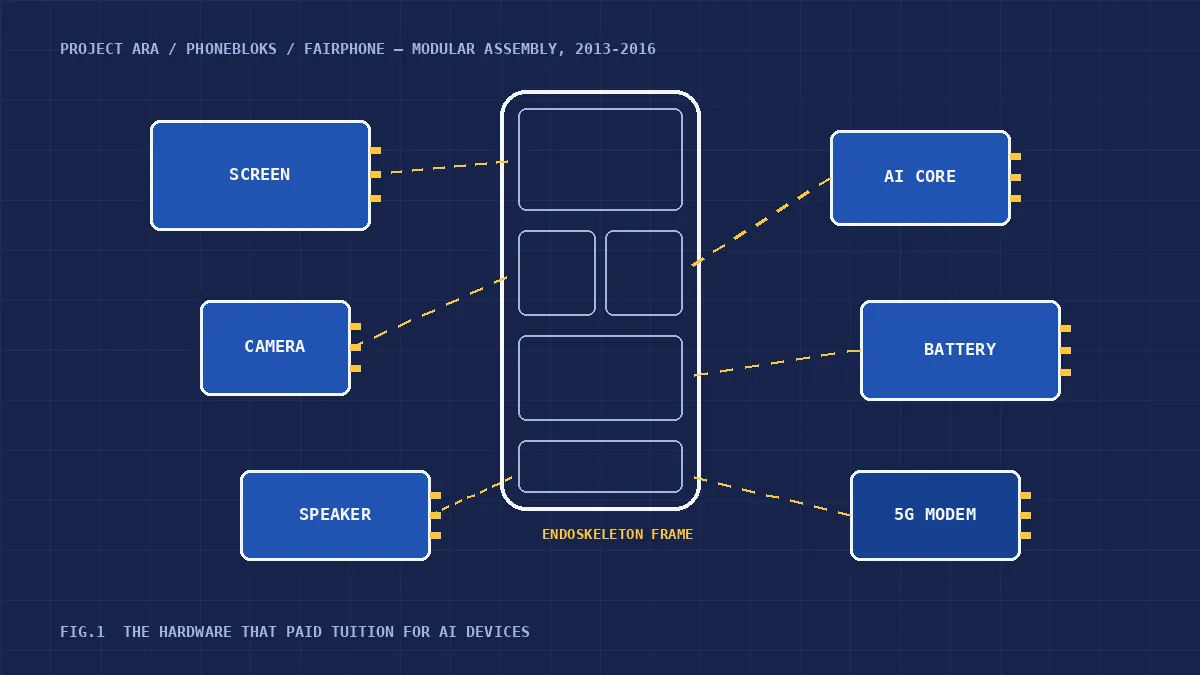
At the heart of the design was a metal frame, with modules held in place by electropermanent magnets. Modules could be swapped, with the concept promising even hot-swapping. Google also envisioned an entry-level version costing just US$50. At Google I/O 2015, a prototype was demonstrated live on stage, to enthusiastic applause.
Then the Compromises Began
Interface durability, data-transfer speeds, device thickness, weight and reduced battery life—engineering realities gradually eroded the original ideal. By the final version announced in 2016, the CPU, battery and display were all fixed and no longer replaceable. Hakkens publicly protested with “Re-think Project Ara.”
That September, Google announced that it was ending the Ara project. There was no product launch. No farewell ceremony.
From time to time, other phone manufacturers have experimented with modular designs, but when it comes to mass production and bringing them to market, there has largely been more talk than action.
Fairphone: Repair, Not Upgrade
While Ara pursued the ultimate vision of “full modularity”, fellow Dutch company Fairphone chose a different path. It shared Phonebloks’ ethical starting point—the fight against electronic waste—but its philosophy was fundamentally different: it did not seek to make upgrading possible. It sought to make repair possible.
The Fairphone 2, launched in 2015, became the world’s first mass-produced modular smartphone, allowing users to replace components such as the screen and battery themselves. The Fairphone 5 later received a perfect repairability score from iFixit. Fairphone remains a niche brand, but it proved an important point: if an ideal is to survive, it must first make compromises with reality.
The Four Walls Modular Phones Hit
- The laws of physics: modular interfaces made phones thicker, heavier and more power-hungry. Consumers ultimately voted with their hands—and chose integrated devices.
- The economics of mass production: more components and larger inventories pushed up costs. In terms of value for money, modular phones struggled to compete with integrated designs.
- Commercial resistance: a phone that could last ten years without needing to be replaced would directly threaten the replacement-cycle revenues of an entire industry. Major manufacturers had little incentive to help such a model succeed.
- User inertia: most consumers wanted something that worked straight out of the box, not environmental responsibility and unlimited possibilities.
Lessons for AI Hardware, IoT and Robotics
Today, the spotlight has shifted towards AI hardware and humanoid robots. Yet the history of modular phones serves as a revealing mirror. A technology demonstration does not equal mass production: the valley of death for hardware is not the launch event—it is the factory. The interests of major players can determine the fate of a technology: products that threaten existing ecosystem revenues may encounter invisible resistance. The learning curve for mass users is another cost that is consistently underestimated: trust and psychological adaptation are often measured in years, not months. And pragmatists tend to outlive idealists: rather than pursuing the perfect vision from day one, it may be wiser to make one specific use case exceptionally reliable first.
Modular phones did not fail. They simply paid the tuition fee early for everyone who wants to change the hardware world. For today’s AI hardware, IoT and robotics entrepreneurs, history is there to be studied—and its lessons are worth learning.
The author is a digital technology practitioner and co-founder of the AI job-search product JobsTaylor.