Media: 联合早报 聯合早報 Lianhe Zaobao
Looking back over the past few years, ever since the debut of ChatGPT, the industry’s center of gravity has shifted repeatedly—at a pace so fast it has been hard to keep up.
In the beginning, everyone obsessed over “prompt engineering,” meticulously refining phrasing and iterating endlessly to coax large language models (LLMs) into delivering exactly what was required. Soon after, attention shifted to the next wave of tools and AI wrappers—covering text, image and video generation, meeting transcription, and more. Applications flourished. The next phase went further: instead of merely adopting tools, users began orchestrating their own AI workflows, building AI agents, connecting knowledge bases with automation platforms, and crafting personalized “digital secretary” functions tailored to specific needs.
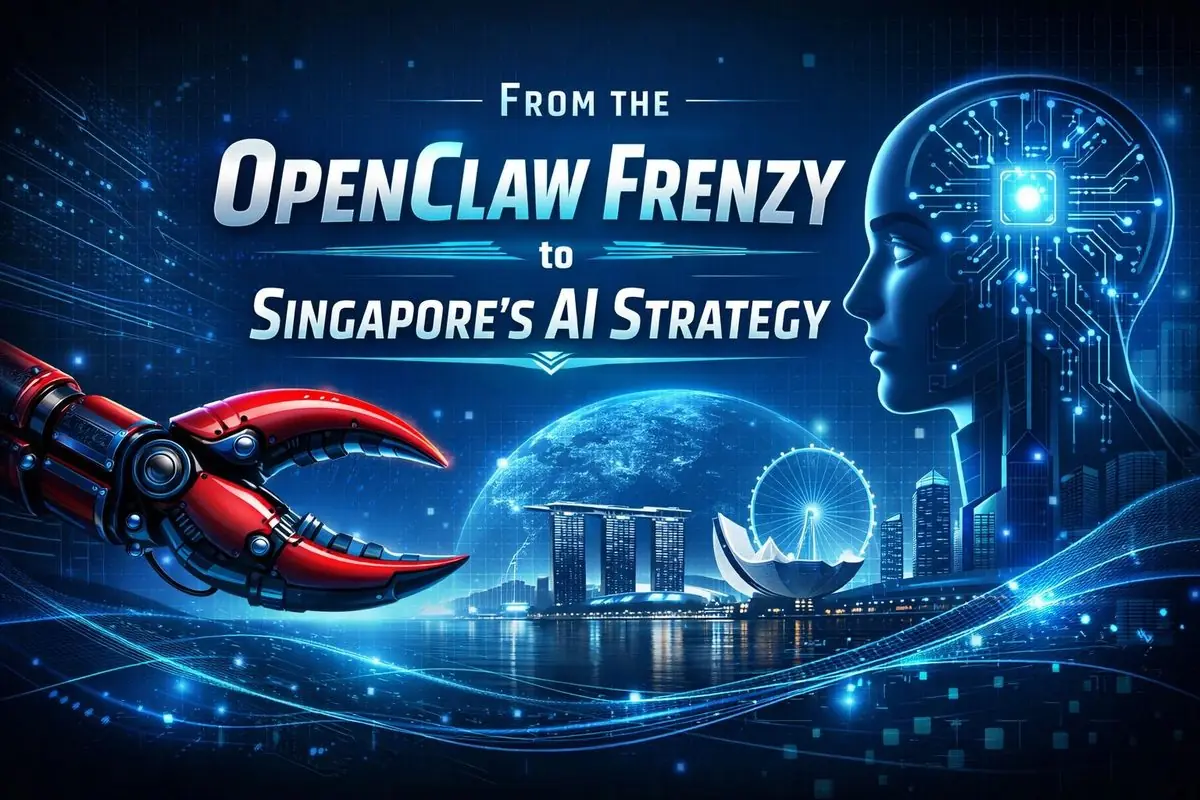
Most recently, OpenClaw—the “lobster” of the tech world—has taken the open-source community by storm. Originally launched as Clawdbot, then renamed Moltbot (reflecting evolution and trademark considerations), it ultimately became OpenClaw, symbolizing the dexterity of a lobster’s claw in executing tasks. Unlike traditional chatbots that simply respond to prompts, OpenClaw can autonomously select and integrate different large language models such as GPT or Claude, and carry out multi-step operations—managing emails, updating calendars, compiling reports, or coordinating cross-application workflows. It can even interact through messaging platforms like Telegram and WhatsApp.
The project quickly went viral in the open-source ecosystem, amassing hundreds of thousands of stars on GitHub within days—making it one of the fastest-growing open-source AI projects in history. In mid-February, OpenClaw announced its transition to an independent open-source foundation, while its founder joined OpenAI—marking a new chapter for personal AI agents. Yet its meteoric rise also sparked debate around safety and control: risks of data leakage, autonomous machine-to-machine coordination, unauthorized actions, runaway resource consumption, and spiraling costs. One widely discussed incident involved a senior global information security executive at Meta, whose system crash nearly wiped his entire email archive after experimenting with OpenClaw.
This wave of AI evolution over just a few years mirrors two decades of telecommunications development. In the 1990s, bulky and expensive mobile phones simply enabled voice calls. The 2G era brought text messaging and incremental features. With 3G in the 2000s, internet access became portable and the world felt smaller. Then came smartphones: Android’s open ecosystem empowered enthusiasts to root devices and customize endlessly, installing tools at will.
AI today feels like the Android era—abundant tools and plugins, highly configurable for those willing to invest time and experimentation, yet with a steep learning curve. It is foreseeable that more integrated, “one-click” systems will emerge—akin to Apple’s streamlined ecosystem: elegant, user-friendly, and seamless, but premium-priced and less customizable, ideal for users less inclined toward technical tinkering.
Open versus closed. Freedom versus stability. The choice depends on one’s needs.
The question, then, is whether we should invest mental energy now to master these tools—or wait for more accessible systems to arrive.
Here in Singapore, the government has offered a clear answer. Positioning AI as central to national development, Singapore is accelerating adoption and transformation across the economy. A National AI Council will focus on advanced manufacturing, connectivity, finance, and healthcare, supported by regulatory sandboxes and strengthened governance frameworks. Enterprises are backed by initiatives such as AI ambassador programs, expanded innovation schemes, and enhanced productivity grants covering digital and AI solutions. A larger AI hub is being developed at one-north to foster collaboration, while skills accelerators aim to upskill professionals. Participants in designated AI courses are even granted six months’ access to advanced AI tools. The goal is clear: harness AI-driven growth to create better jobs and higher wages.
Technological change has never waited for anyone. It rewards adaptation and leaves behind those who hesitate. Observing from the sidelines may conserve effort—but risks forfeiting first-mover advantage. As personalized workflows mature and automation reduces operational costs, workforce restructuring becomes inevitable. Work itself may grow more fragmented. Coupled with concerns over energy consumption and computational strain from AI overuse, the road ahead may not be easy.
The only viable response is steady composure—and relentless learning.
Talk to us to solve your digital challenges.
#AI #AartificialIntelligence #AI #AgenticAI #AIWorkflow #Tech #OpenClaw #Opensource #Singapore #SingaporeAI #AIAgent